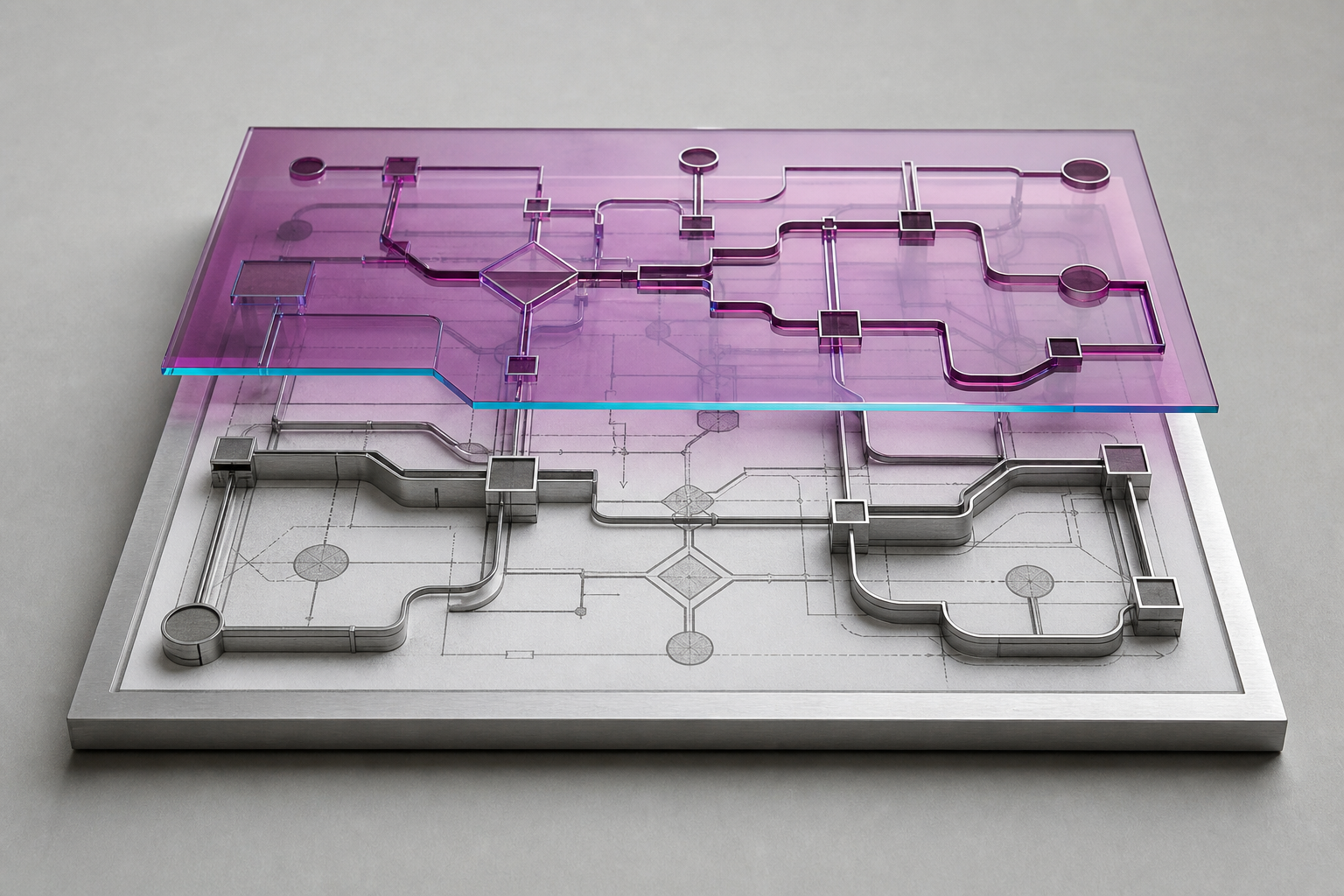
Growth still requires constant intervention.
Important decisions, approvals and problem-solving repeatedly return to the founder.
- Managers follow up instead of owning outcomes
- Execution slows when leadership is unavailable
We engineer the operating infrastructure that turns growing companies into clear, consistent and autonomous organizations.
Explore the engagement ↗When scale outgrows informal management, information fragments, decisions slow down, and the founder becomes the system. We replace that fragility with an operating architecture your people can actually run.
Typically ₹5Cr–₹250Cr in annual revenue. The common factor is a business that has outgrown informal management and is ready to build a lasting operating system.
Important decisions, approvals and problem-solving repeatedly return to the founder.
Processes live in individual memory, forcing the company to repeatedly rehire and retrain from the beginning.
Business data, workflows and accountability are undocumented or fragmented across disconnected tools.
The company understands the problem is structural and is prepared to invest time, attention and capital in implementation.
Not isolated advice. A connected operating environment designed around how your company really works.
Roles, decision rights and accountability designed so work never disappears between departments.
Workflows, SOPs, approvals and escalation paths that turn best practice into daily practice.
Reporting cadence, dashboards and governance rhythms that give leaders control without constant intervention.
The work moves in sequence so the company understands the problem, builds the right system and learns how to own it.
Audit the real flow of work, information, decisions and dependencies.
Define ownership, workflows, controls and the operating model.
Create the documents, tools, dashboards and training your teams need.
Establish adoption, review and improvement rhythms that endure.
These are examples of the infrastructure built during an engagement—not claims about a completed client transformation.
Current-state assessment, bottleneck register and systems inventory.
Workflow maps, approval routes, escalation paths and decision rights.
Responsibility matrix, role clarity and management accountability.
Dashboards, review cadence, adoption controls and internal handover.
Ragaventhra Systems is led by Arish Ragaventhra, Founder and Lead Advisor. Structural decisions are developed with leadership, tested with the people doing the work and carried through implementation.
Meet the firm ↗Practical analysis of founder dependency, process architecture, governance and operational technology.

Why capable teams still wait for one person—and what must replace that dependency.
Read insight ↗
Documentation creates reference. Governance turns it into consistent execution.
Read insight ↗
A tool cannot resolve a workflow the organisation has not yet agreed.
Read insight ↗Start with a focused conversation about where execution is breaking down and what needs to change.
Begin the conversation ↗